![]() |
| Michael Mann Public Enemies Interview |
Michael Mann (commonly misspelt Michael Man) is one of the most respected film directors of this generation. This blog is for all those who appreciate Michael Mann's work on the big and small screen. In following Mann's movies I find myself drawn into a world I occasionally become profoundly moved by. Come visit if you want to hear all the latest Michael Mann news I discover on the web.
Thursday, 1 December 2011
Public Enemies Michael Mann and Actor Interviews
Friday, 12 August 2011
Video Essay: Justice, Vengeance, and Empty Retribution in Public Enemies
Tuesday, 22 March 2011
Michael Mann commissioned new font for Public Enemies
"For his upcoming “Public Enemies”, a crime drama set in the 1930′s, he commissioned Neville Brody to design New Deal, an original display typeface for titling and promotional materials. The face was specifically designed with the imperfections of the period taken into account–as signage was often done by artists who weren’t themselves dedicated type designers–resulting in a quirky, uneven character."Click here for full article.
According to Creative Review:
"Jeff Knowles and Neville Brody have been working on the project, having previously created the typeface for Heat and The Insider."For more information about this font and the designers, see the links below:
http://www.creativereview.co.uk/cr-blog/2009/may/new-deal-typeface
http://www.researchstudios.com/
Monday, 21 February 2011
New Aesthetic Form in Michael Mann's Public Enemies
In making "Public Enemies," Mann opted for digital high definition video for the very reason I once thought it could never achieve the aesthetic appeal of film imagery—its "nowness." In interviews Mann has stated that in telling Dillinger's anti-heroic, Depression-era story, he did not want the distancing, nostalgic look conveyed by conventional emulsions. Rather he wanted the viewer to have a sense of 1933 happening in the present, a visual "now" style which he said might suggest a "hyper-reality." That style is as compelling as the narrative it underwrites. And having seen the movie a second time, closely studying the way the digital high definition camera can be used to create a new, uniquely expressive form of screen art, I must confess I can see a real future for it in movie theaters. With "Public Enemies," Michael Mann has paved the way.
Read more >
Tuesday, 15 February 2011
Johnny Depp getting into character for Public Enemies
Exclusive - Public Enemies Filming Footage on Set from HeyUGuys.co.uk on Vimeo.
Friday, 4 February 2011
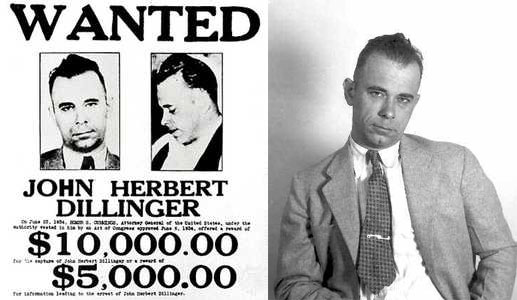
Public Enemies historical Information
![]() |
| John Dillinger and his wanted poster |
![]() |
| Thompson SubMachine Gun |
Find the article here.
Below are some snippets about the real John Dillinger, and his death in the film is featured at the bottom.
Saturday, 29 January 2011
Michael Mann Public Enemies Interview
Michael Mann:
So, with Homer, outside the bank, and he sees that police car drive up. There’s a close-up--it's something you can only do in hi-def--I've got the lens right here, and you’ll just see the focus shift to right to the stubble, and then I’m heightening that and color timing by raising the contrast just when we get there. So, you really feel you’ve gone right into Homer, and you can feel his awareness just climb up. There’s no nervousness, there’s nothing. But, you see he has totally taken in the arrival of the cops outside.
And so, I look for those moments. I look for where or how to bring the audience into the moment, to reveal what somebody’s thinking and what they’re feeling, and where it feels like you’re inside the experience. Not looking at it, with an actor performing it, but have an actor live it, and you as audience, if I could bring the audience inside to experience. It became critical in THE INSIDER, because the ambition was to make a film that was as suspenseful as I knew, and dramatic as I knew those lives really were. And, it’s all talking heads, but the devastation, the potential devastation to [Jeffrey] Wigand and Lowell Bergman was total annihilation, personal annihilation, suicide--all that was in the cards for these guys. And, yet, it’s all just people talking. So, that kind of began an exploration into how I could bring you into experience in as internal a way as I could.Full article here.
Friday, 21 January 2011
Camera used on Michael Mann's public enemies
![]() |
| About 95% of Public Enemies was shot with the Sony F23. |
Do you fall weak at the knees whenever you see a gorgeous.... camera? If so, then we are alike. I love cameras (and yes, I would love a RED). We all know they are a workers tool, and nothing more. But a workman gets attached to their tools, and I am very sentimental about all the cameras I own. So, for all the camera buffs, here is an interesting mann link on the camera used for Public Enemies – The Sony F23 (which unlike the RED, isn't that pretty).
Here is an extract of the article – for the full link, click here.
A few months before principal photography began on “Public Enemies,” Mann and Carroll tested the F23 on a series of commercials. On one set, it was mounted to a race car driving at speeds of up to 140 miles per hour. On another, it was handheld with the operator running between football players on the practice field to capture the shots. “The F23’s ergonomics, film-like design and incredible amount of features – such as multi-speed recording, ramping and, of course the 4:4:4, 10-bit quality – proved to be bullet-proof,” Carroll said. “The camera just works and does its job.” About 95 percent of the movie was shot with the F23, while the Sony PMW-EX1 camcorder handled shots that required a more mobile tool. For example, the compact EX1 camcorder was used to lens the interior of planes and cars during high-speed chases.
Sunday, 2 January 2011
Michael Mann Public Enemies Extras shots
http://www.flickr.com/photos/10705640@N00/2471075812/in/photostream/
Here are some others I may not have posted before:
http://www.flickr.com/photos/diginux/2393455546/in/set-72157604367390672/
I really need to somehow get on one of Mann's shoots just for the love of it... anyone know how to do it?
Tuesday, 9 November 2010
Michael Mann and the Cinematic Close Up
I look for where or how to bring the audience into the moment, to reveal what somebody’s thinking and what they’re feeling, and where it feels like you’re inside the experience. Not looking at it, with an actor performing it, but have an actor live it, and you as audience, if I could bring the audience inside to experience. It became critical in THE INSIDER, because the ambition was to make a film that was as suspenseful as I knew, and dramatic as I knew those lives really were. And, it’s all talking heads, but the devastation, the potential devastation to [Jeffrey] Wigand and Lowell Bergman was total annihilation, personal annihilation, suicide–all that was in the cards for these guys. And, yet, it’s all just people talking. So, that kind of began an exploration into how I could bring you into experience in as internal a way as I could.
Sunday, 31 October 2010
Elliot Goldenthal working with Michael Mann on Public Enemies
Here is a Wall Street interview with Elliot Goldenthal on working with Michael Mann on the Public Enemies score. A snippet is below, and you can click here to go to the article.
You’ve worked with Michael Mann on “Heat” and now on “Public Enemies.” I sense music is important to his films. True? How is he to work with?
He doesn’t like too many twists and turns in the music’s structure. He really responds to things that evolve very, very slowly. He wants music that the images, the edits, the dialogue can float above without it corresponding too much. With Michael, you have to be prepared to make a lot of changes. He changes his mind. He watches the movie everyday in total and makes adjustments so you have to know the job is making adjustments along the way as well.
What’s your reaction to your music when you go to a movie theater and see a film you’ve scored?
It never feels finished. That’s the thing. My personal view of my work is that everything feels abandoned.Click here for full interview
One of the more moving pieces on the Public Enemies soundtrack is JD Dies (in the clip below).
Overall, I don't think Goldenthal defines Public Enemies in the way that say Moby or Lisa Gerrard have in the Mann movies they have been involved in. I find it surprising that Mann hasn't been tempted to do a collaboration with Hans Zimmer. Who would like to see that happen?!
Compare JD Dies with Chevaliers de Sangreal, which is taylored for Cathedral like grandeur. Breathtaking scoring. Hans Zimmer is a musical genius.
Tuesday, 19 October 2010
Michael Mann's Public Enemies: Perspective from someone on set
![]() |
| The set of Public Enemies. Photo by Rob Olewinski. |
By Ignatiy Vishnevetsky
I spent a few days in the summer of 2008 on the set of Michael Mann's Public Enemies, which was shooting at the time in Chicago. It was a night shoot—the death of John Dillinger (played by Johnny Depp) in front of the Biograph Theater. These observations and ruminations, which will be posted in three parts, were written at the time. Portions of these notes have since been used in other pieces, including a few posted here at The Auteurs' Notebook. Dispatches Part 2 can be found here, and Part 3 can be found here.
***
I've seen John Dillinger shot many times. Once, it was Warren Oates who got gunned down. I've seen it happen to Lawrence Tierney, too, and then there was a soft-focus re-enactment in a television documentary, an anonymous actor in front of an anonymous movie theater. But how many times have I seen Johnny Depp get shot now? Each time, it's more or less the same (but of course, every take is subtly distinct, which is why we have multiple takes). The artificial streetcorner with the alley. He walks along the sidewalk, dressed in a summer shirt and straw hat. The streetlight falls on his back, a crease in the shirt formed a shadowy valley. I imagine it as an image—the shirt as a landscape—and I think: "I want to wear my shirts that way, a little untucked." Depp doesn’t look like Dillinger, but it doesn’t matter. That rakish face looks like how Dillinger should feel. Dashing, like a vagabond—the way we want Our Dillinger (there’s that Chicago logic, that funny way we cling to our monsters: they might not be good people, but they’re our people). A man comes up from behind and clicks the prop gun. Again and again. Depp falls forward, and the camera, handheld, follows the movement of his body, plunging as he crumbles.
The film is being photographed in HD, but this shot, in slow motion, is being filmed on an unblimped 35mm camera. It's got a furious, high-pitched clicking. On the video assist monitor, we can see the angle: the cameramana following Depp from behind. While they repeat and repeat and repeat the shot, technicians light the next scene, which will be in front of the Biograph Theater itself. The marquee has been redecorated so that it looks like it did when Dillinger was shot there. They're working diligently, separated from the current set-up by a throng of extras who stand silently, arms folded, watching Depp die, hopeful to glean some bit of "genius" to further their acting careers. A large camera sits on a dolly, covered by a transparent plastic sheet like a couch in a furniture showroom.
And of course, I’m thinking: "In life as in the dictionary, ideas come before images." Here I know the image, but I don’t know the idea. It becomes the great game of film-viewing, watching through the video assist a rough estimate of an image that hasn’t been made yet. An image that might not even make it into the movie. The thing about cinephiles is that, when you take us out of the cinema, we get hungry. We latch on to everything that might resemble a movie. The onlookers have their Depp, I have my little screen.
Some directors sit in a folding chair in headphones, watching the video assist. Some talk through their assistants. Michael Mann directs standing up. During every take, his attention darts from the monitor (there is only one and only one camera; two more monitors are set up with the little tent to shelter them from rain, but they're blank) to the action going on twenty feet in front on him and back. A director is responsible both for something real and something filmed. A director is two people at once—a director, supervising some real event, and a filmmaker, shaping some future image.
Mann paces. After every few takes (and of this shot, there'll be dozens) he darts over to the actors. He takes Depp aside, standing close to him, talking over actions and movements which the actor occasionally mimes out. On this hushed street, you can hear just about anyone’s voice, but not Mann's. He talks quietly. Or, maybe, he talks just as loudly as he needs to.
Over the years, Mann's approach has changed. At the beginning of his career, he seemed like a contemporary of Jean-Jacques Beineix. He was the Beineix who wasn't a misanthrope. Now he's the only obvious contemporary to Claire Denis and Johnnie To. His career is the story of a director who began with "the look" and discovered the image. From the "cinematic" to cinema. The Mann of Thief through Manhunter, like Beineix, seemed to care about the appearance of the image more than the image itself. They're good movies, but making good movies isn't enough. It was about staging things for the camera more than capturing an image. Closer to a photogram than a photograph. I remember a scene from The Keep like I do a scene from Beineix' The Moon in the Gutter: I remember the color, the lighting, but not whether the images were close-ups or wide shots, whether the camera moved, whether it was one shot or several. Even The Last of Mohicans seems to have been made by someone thinking: "What if we made a movie that looked this way?"
He's always worked on location. Back then, he'd start with something at least partly real and make it feel completely artificial, completely plastic. I recognize Lake Michigan in Thief, but only the way you recognize a triangle or a square. What I see first is a color and a line. Images that sort of scuttle themselves, marooning the viewer. (It's possible to also think of a roster of ferrymen, directors who use the film to row the audience out to a certain place and then bring them back in time for the end credits: Shirley Clarke, Eric Rohmer, Yueh Feng, Charles Burnett, David Mackenzie, Kiyoshi Kurosawa, Aleksandr Sokurov. These directors should not be confused with kidnappers like Santiago Alvarez or gallery guides like Peter Greenaway.) But something happened around Heat. Aesthetics gave way to ethics, imagery to images.
The first shot of Thief and that final tableau from Heat are obviously directed by the same man—or at least by the same tastes—but the ideas aren't the same. It's the difference between letting your tastes find something and having a feeling inside you that you use your tastes to express. The first shot of Thief and the last shot of Heat: rumbling electronic music, night time, lights forming a V shape that disappears on the horizon. In Thief, it's a man getting into a car and driving away. In Heat, it's two men perfectly still. Funny how it's only in a moving image that we can really capture stillness. In neither image are the figures "acting" in the traditional sense. James Caan just gets into a car. Robert De Niro and Al Pacino pose; they look like statues (but then I think: "Statues also die."). Similar images, but not the same. Like that conversation De Niro and Pacino have in their only other scene together in the film, the final shot of Heat is Utopian. Two people expressing themselves completely and shamelessly. I think it's that ideal that Mann has aspired to since: to let go of preferences, of standards in framing, editing, composition and to express whatever he might be thinking or feeling through the image. Instead of simply telling their stories, he will become one with the characters he admires.
Watching the death scene in Public Enemies, repeated over and over, I realize that there are really two key performers here: Depp and the cameraman. Two well-rehearsed actors. Since Collateral, Mann has been treating the camera more and more like something that can perform. No one else has shots so actorly, expressing in grand gestures but also small nuances. I think of the way the camera pulls back as Jamie Foxx scrambles out of his taxi, and how Foxx's terror is nothing without the camera's movement.
Read this article here
Read Part 2 here
Read Part 3 here
Saturday, 11 September 2010
Shooting Public Enemies
Here is a brief extract of what is a long article:
“We did tests down in the parking lot [of Mann’s offices], set up with some posters from 1933 and cars and lights,” Spinotti says. “We did side-by-side tests with a film camera next to the F23, shooting daytime and going into twilight and then night. We also did various lighting tests. Company 3 [Santa Monica, Calif.,] did the transfer for both, scanning the film and then bringing the digital files into a digital negative and then printing, and then we compared film prints. The results were interesting: The F23 was extremely sharp, probably a bit sharper than film itself. The tonal range wasn’t the same as film—we all know the tonal range of film holding onto the highlights is extraordinary and digital hasn’t quite met that yet. But nevertheless, the way that digital dealt with shadows, really reading into shadows and darkness and doing it with extreme sharpness, convinced Michael, and I agreed: The way to go was digital. The other consideration was the agility and elasticity of working with those cameras and how Michael could work his preferred way. All this would let him go into an area that is almost hyperreal.”
Read the Full Article: Click Here
Sunday, 29 August 2010
Mann gets his coffee... any way he wants!
At one point Michael asked for coffee. No one wanted to ask him cream? Sugar? Black? Decaf? So they bought 3 of each – black, cream, cream and sugar, sugar, sugar substitute… decaf with the same routine. About 20 cups of coffee so that one of them would meet his requirements. Wow… This was my first hint that this guy GETS WHAT HE WANTS!!! No questions asked!
Get the full blog experience here - it's fun to read.
Darn, I wish I could get on a Michael Mann set, just to know what it's like. I have never been on a movie set, not least a Mann movie. No, that's a slight lie. I did find my way by accident on the set of Wind in the Willows near Farnham, Surrey. But they were packing up so I saw very little. I mean guys, Wind in the blooming Willows.
Sunday, 22 August 2010
Some new links
A useful perspective on Public Enemies is provided by one blogger:
waysofseeing.org
YouTube has a good source of videos made by fans of some iconic scenes in Mann's movies. There are various tribute videos available, but here is one for your convenience:
Thursday, 7 January 2010
Wednesday, 6 January 2010
Minimalism, Michael Mann and Miami Vice
I have been away a while due to heavy work and other commitments - the usual juggling of life! Yet my passion for Michael Mann films does not wane. Some folk may be wondering where my review is of Public Enemies. I did of course see it at the movie theatre, and I do of course have an opinion on it. Yet with Mann movies, as I have said before, they seem to get better with age and repeated viewings. I am not entirely sure why this is. I think it is because each frame in a Mann shot is so packed with "essence" that it is impossible to take it in a single viewing. The Public Enemies DVD (two disc edition of course) was on my Christmas list and I was thrilled to get it from my lovely sister. Whilst Mann films are undoubtedly made for the big screen, there is also something very intimate about watching a Mann film on your own TV, in your own lounge, lights dimmed or better off, at the right viewing distance and, importantly, alone. Only then can you immerse yourself not only into Mann's world, but into your own, as you allow your emotions to manifest, even overflow. It is a response not only to the characters you are watching, but there is this deep level reflection into your own self.After several viewings of the DVD I will come back to write my thoughts.
One blogger helped crystallize how I perceive some of Mann's recent movies (Public Enemies and Miami Vice), referring to the stripping down of character backgrounds. The following is an extract by Khoi Vinh from www.subtraction.com:
“Public Enemies,” continues Mann’s ongoing exploration of a stark, almost ascetic kind of narrative sensibility. With a nearly impudent disregard for common storytelling conventions, the director has in recent years taken to gutting from his works anything and everything that might be superfluous to the forward momentum of his core narratives. He affords his characters practically no backstory or prehistory, his plots are reduced to the threadbare, and subplots are often extracted altogether. Including “Public Enemies,” his past three movies are so elemental and succinct (not necessarily in running time, but in scope) that they’re just as much like episodes within a larger series of events as wholly contained feature films of their own.
What’s left out from these movies is as important and beautiful as what’s included. They’re exercises in doing as much as possible with as little as possible, implying whole swaths of narrative information by allowing the audience to extrapolate events, details, backstories and subplots from only the barest hints of their presence. In fact, what Mann is doing here (and why I am so obviously drawn to this sensibility) is designing these stories — not just their presentation but more fundamentally their construction, too — and doing so in a way that evokes many of the very same things that thrill me about design.
Mann employs an architectural approach that establishes a plot framework but declines to fill every nook and cranny. He uses very few elements to suggest many more, and in so doing constructs a kind of environment that the audience experiences rather than a narrative account that the audience observes. This is very much minimalism and experience design at work; it just happens to star Johnny Depp, is all.
Saturday, 3 October 2009
Michael Mann Interview: "I'm interested in extreme conflict"
http://www.guardian.co.uk/film/video/2009/jul/02/michael-mann-public-enemies
Thursday, 30 July 2009
Your views on Public Enemies - post them here!
Although I am presently "lost" in the Outer Hebrides of Scotland with no hope of seeing Michael Mann's Public Enemies until the 7th July, I am sure you will be lining up to see the movie on its opening public debut. I really want to hear all the feedback from all you Michael Mann fans, so having seen the film please leave your initial comments, views and reviews in the comments under this post. Should be fascinating to see the responses from you guys.
I have made this post a "sticky", so don't miss any new posts below this one.
Tuesday, 30 June 2009
Mann HD Public Enemies Interview
http://www.youtube.com/watch?v=oFCUL4pwx2Q
It isn't a great, flowing interview, but it is nicely shot and there are some signfiicant director insights into the movie, so well worth watching.


