Michael Mann (commonly misspelt Michael Man) is one of the most respected film directors of this generation. This blog is for all those who appreciate Michael Mann's work on the big and small screen. In following Mann's movies I find myself drawn into a world I occasionally become profoundly moved by. Come visit if you want to hear all the latest Michael Mann news I discover on the web.
Monday, 1 August 2011
Michael Mann's Ali and Lister fight
Wednesday, 23 March 2011
Testing the "truth" of Michael Mann's "The Insider"
The reason I write about this is because of an article I found which delves under the factual content of Michael Mann's The Insider. When The Insider was released as a dramatized version of events surrounding Jeffery Wigand, Lowell Bergman and Brown & Williamson it was immediately open to scrutiny, mainly from the real life characters the film served to depict. Wallace was particularly unhappy. All these criticisms have been openly reported and Mann has responded to them honestly and admirably.
However, the article I have found is useful as a way of understanding indirectly some of Michael Mann's approach to "truth" and his philosophy and purposes towards storytelling. Revisionist history is always never far away from film creation. Click here for the article, but a brief excerpt is below to set the scene.
[11] But then all of a sudden something even more astonishing occurred to me. Instead of objectively seeking out the truth behind The Insider like I had planned, I had fallen victim to the lure of Michael Mann's convincing enplotment! By immersing myself in the movie, I had unknowingly accepted Mann's filmic version of the truth. Because I formed an emotional attachment to the likable characters of Wigand and Bergman, I never once hesitated to believe their stories. Thankfully, extensive research forced me to be a more critical analyst, and I saw how Mann had twisted and manipulated various scenes and real-life characters to his advantage as a filmmaker."Michael Mann's The Insider - History Redefined." 123HelpMe.com. 23 Mar 2011
http://www.123HelpMe.com/view.asp?id=20638
Friday, 31 December 2010
The Keep analyzed by FerdyonFilms
An extract is below, but the full article can be found here:
Like Ridley Scott, Terence Malick, and a few other visually oriented directors of the time, Mann experimented with dispensing with the traditional brackets of narrative and tried to realise story through a kind of running montage. The Keep builds to one of Mann’s most hypnotic climaxes, cutting between Cuza bringing a gleaming talisman out of the cavern, and Glaeken climbing out of the ravine to save the day. The human and elemental dramas dovetail at last when Eva tries to prevent her father from removing the talisman from the Keep, prompting Malasar to demand of Cuza that he kill her and move on. As if in humanistic rewrite of the Abraham and Isaac myth, Cuza turns on the beast and demands of it, “Who are you that I should prove myself by killing my daughter?” before insisting that if the talisman is Malasar’s, he should be able to take it out himself. Infuriated, Malasar reduces Cuza to his crippled state again, but before he can kill Cuza and Eva, Glaeken walks in with his cosmic bazooka to scrub Malasar out, even at the cost of his own life on earth.
Read full article
Monday, 27 December 2010
The Conversations: Michael Mann
There is an awful lot of information out there about Michael Mann, and views on his films. Here are some ramblings covering most of Mann's movies. I don't agree with all they comment on, but there are some useful comments for those studying Mann. The screenshots are a good touch too.
Here is the link.
Let me know if you want me to cover anything specific, that you haven't yet found on this blog. If anyone reads this blog and has been part of his crew, would be great to hear from you, even if off the record (which I always respect if requested).
Thursday, 9 September 2010
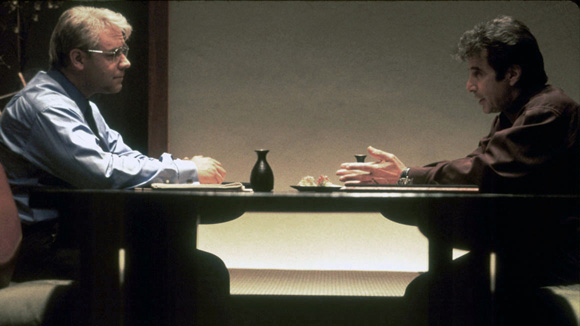
Top 10 performances from Michael Mann films
![]() |
| Russell Crowe & Al Pacino in The Insider |
The result of this hard work has been a slew of captivating, at times career-best performances from some of the most accomplished actors working today. A Michael Mann production represents the opportunity to go deeper with a performance and perhaps even learn more about the craft. Will Smith has frequently discussed his collaboration with Mann as the most rewarding experience of his professional life. And, as Javier Bardem once told me, “When Michael Mann invites you to his party, you don’t turn him down.”
So with that, a collective representing the best performances to come from Mann’s 10 feature films to date seemed the best way into this week’s installment of The Lists.
To read the full article and see the author's TOP 10, CLICK HERE
Monday, 13 April 2009
Gravity of the Flux: Michael Mann’s Miami Vice
The film closes as abruptly as it opened: Isabella escapes from the flux by the sea (the eternal utopia of Mann’s characters): “It’s magic”, says a fisherman about the sea near the beginning of Thief (1981), Sonny turns his back on the sea and returns to the flux. And loses himself therein. Life suspended on one side, perpetual flux on the other. No dead time or respite: the system runs at full speed but on empty, and possesses no other end than that of its own stability. To such an extent that one could, like Isabella, pass one’s entire life there: “It’s all that I know how to do; I’ve been doing that since I was 17”, she tells Sonny when the latter questions her on the possibility of an elsewhere, of an alternative life. The only thing that counts is the global balance of the system and its capacity to restore the unchanging order of things (disappearance of Jesus Montoya/death of Jose Yero, disappearance of Isabella/reappearance of Trudy, etc.). At bottom, between the beginning and the end of the film, nothing has changed. Like Frank (James Caan) at the end of Thief or Lowell Bergman (Al Pacino) in the last shot of The Insider, Sonny recedes in depth of the field, with his back to us, and disappears. In the world in flux that Miami Vice follows, the human is only an event, a lost atom in the multitude, similar to the one described by the hired killer in Collateral. It is either arrogance and/or naïveté of the couple, Sonny-Isabella, to have believed that the human could be stronger than the flux.
See the full article here >
Michael Mann's cinema of images - Anna Dzenis
Michael Mann's cinema of images
Anna Dzenis
Stanley Kubrick. Eisenstein. Dziga Vertov. And 'Kino Eye'. I mean that's really my limitation. So my approach to films tends to be structural, formal, abstract and humanist. (Michael Mann) [1]
Michael Mann has been a writer, director, producer and an actor on a range of film and television projects spanning a period of over thirty years. He has also been writer, director and producer on most of his own films. He has a significant body of work to his credit. And yet -- curiously and surprisingly -- his work has not received a great deal of critical attention.
David Marc and Robert J. Thompson's book Prime time, prime movers[2] devotes a chapter to Michael Mann in a survey of key creative contributors to prime time American television. He is also represented in Jim Hillier's book The new Hollywood[3] as one of the few creative personnel who shifts fluidly between the big screen and the small screen. Acknowledgement of his contribution as one of America's great film directors has been less well documented. This, however, has been slowly changing. He is included in the recent Wallflower critical guide to contemporary North American directors[4]. And Pocket Essentials have just published a slim book on Mann in their Directors Series [5]. There are also a number of longer essays, written after the release of each new film; Gavin Smith's essay, written after the release of The last of the Mohicans[6], Richard Combs'[7] and John Wrathall's[8] essays, written after the release of Heat. Nick James'[9] and Christian Viviani's[10] essays which follow the release of The insider. And Adrian Wootton's[11] and Legar Grindon's[12] essays on Ali. There is also Jean-Baptiste Thoret's important essay "The aquarium syndrome: on the films of Michael Mann." [13] In addition to this, Mann himself has actively contributed to the literature surrounding his films by giving a number of lengthy interviews. Amongst these is an important early interview with Julian Fox which appears in Films and filming[14] after the release of his first feature film Jericho mile; an interview with Harlan Kennedy where he discusses The Keep [15]; a key interview anthologised in Projections 1 [16] where Mann discusses The last of the Mohicans; an interview in Sight and Sound [17] where he also discusses The last of the Mohicans; and an interview with Geoff Andrew in Time out[18] on Heat.
What this handful of writers, essays and interviews all share is a recognition that Mann is the author of the films that he has directed. What they also share is a tendency to scrutinise the films for traces and marks of authorial enunciation, for the signature and voice of the author. And while the films certainly support these auteurist readings, there remains something else, something elusive and resistant about the cinema of Michael Mann, something that provokes Richard Combs to describe his own essay on Heat as an "interim assessment of the interim nature of Michael Mann" [19].
The style and stylisation of his films is part of the explanation of both some of the elusive and resistant elements in Mann's cinema, and the existence of so few serious essays, and only one book-length study, about his work. This critical neglect relates to a larger issue: the limited critical and analytical attention in studies of the cinema to the work of film stylists, and matters of style more generally. In this essay I want to make a small contribution towards redressing this imbalance by exploring critical elements of Mann's audio-visual palette, his distinctive sound-image fusion and the ways in which stylistic elements are linked to a narrative of desire in Mann's cinema. I also want to suggest that not only is a particularly commanding art of image and sound central to Mann's style but that images, ideas about the image and the desire for the image are also central to the theme and content of a Michael Mann film.
The Pathos of the Photographic
The magnificent Ambersons is one of a group of great films that have built the pathos of the photographic into their textures and made it part of their thematic material. (V.F Perkins)[20]
Films whose textual economy is pitched more at the level of a broad fit between elements of style and elements of subjectWorks by Robert Altman, Michael Mann, Abel Ferrara, the Coens and Alan Rudolph provide relatively distinguished examples of this practice, in which general strategies of colour coding, camera viewpoint, sound design and so on enhance or reinforce the general 'feel' or meaning of the subject matter. (Adrian Martin).[21]
A number of elements characterise a Michael Mann film. To begin with, Mann is recognized as a director of genre films -- specifically crime stories, and also action/adventure films. Secondly, his films are complex and elaborate investigations into character and personality -- primarily focused on the relationships between men. Third, his work exhibits a continuing quest for a more epic, monumental form of storytelling, for the ever-longer story arc. And fourth, there is a realist impulse that is realized in the stories he tells and the actors he chooses to work with. However, what is most distinctive about the cinema of Michael Mann, what is most remarkable and most problematic for some, is his style and stylization. What makes his films more than just genre films is his experimental audio-visual palette -- the way that images and sounds function poetically, materially, sensually and affectively.
Some early critical reaction to his work pivoted around the accusation that he was a stylist without substance. These accusations were partly tied to his association with Miami vice and a particular reading of that series which suggested that it was only concerned with glossy surfaces and glorious images. But there are others who have found cause to compare aspects of his oeuvre to some of the greatest cinema stylists. And in doing so, they have situated his work in a lineage of the greatest filmmakers in the history of the medium. His attention to detail, his obsessiveness and the length of time it takes him to complete his films has been compared with Kubrick. His lateral tracking camera movements have been regarded as mercurial as those of Max Ophuls. His compositions, his experiments with colour, and the way in which he selects and renders architecture have invited comparisons with the work of Antonioni. And, in a recent article, in which film-makers nominate the films of their "imaginary cinematheque" [22] Olivier Assayas positions Mann alongside Bresson, Tarkovsky, Pasolini, Visconti and Hou Hsiao Hsien
But while there are evident claims for Mann's status as a great stylist, I also want to propose that Mann is not a stylist who simply glories in the display of style for its own sake, in the pyrotechnics of style's performance. In a remarkable essay tracking the many practical and critical approaches to film style, Adrian Martin proposes a 3 tier model of style-subject relations.
First are those films and directors that still 'essay a strategy of style' in the classical sense works in which there is a definite stylistic restraint at work, and in which modulations of stylistic devices across the film are keyed closely to its dramatic shifts and thematic developments"
Second are films whose textual economy is pitched more at the level of a broad fit between elements of style and elements of subject.
Third are mannerist films..in which style performs out on its own trajectories, no longer working unobtrusively at the behest of the fiction and its demands of meaningfulness. [23]
In this essay Martin situates Mann alongside contemporary directors like Robert Altman, the Coen Brothers and Abel Ferrara -- film-makers for whom there is a "broad fit" between form and content, style and narrative, technical choices and the story that is being told. But he also goes on to say that many film-makers wander between these categories. He gives the example of Scorsese as someone whose "characteristic style virtually functions on all 3 tiers simultaneously".[24]
This observation about "a broad fit between form and content" certainly characterised Mann's style in the early nineties. However, Mann's more recent approach to style-subject relations can be better described as wandering between "close-fit" and "broad-fit" stylistics, at times classical and at other times almost mannerist. Dante Spinotti, Mann's cinematographer on four of his films, described the director's visual processes in the following way. "It's a little like being in front of a Caravaggio scene and changing it into a Kandinsky painting." [25] The Kandkinsky-like qualities Spinotti is evoking are Mann's intoxicating passion with the painterly, expressive, plastic possibilities of the cinema, with the way that framing, colour and light can transform a room in a house or a street at night. But while images in Mann's films can sometimes be abstracted, expressive or surreal they are almost always tied to a character's point of view, or the mood of the narrative, and always linked to emotion and affect. When Spinotti was interviewed about the "look" of the film Manhunter, he spoke of the way the choices of colour and light were based on emotions and desire. The examples he gave were "the romantic blue" light that cloaks the lovers in the beach house, and "the unsettling purple light" invading Dollarhyde's house in the film's penultimate climactic shoot-out.
In his BFI book on The magnificent Ambersons V.F. Perkins described Welles's film as one "of a group of great films that have built the pathos of the photographic into their textures and made it part of their thematic material" [26]. Perkins positions Welles with a group of filmmakers -- Mizoguchi, Max Ophuls and Jean Renoir -- "notable for the way that the steadiness of the camera's attachment to a passage seems gauged to capture movements into the distance, the dying of the light, fading of an echo, in relation to the longing to hold the moment and to escape with it outside time" [27]. Perkins is talking here quite specifically about the long take and the way it enables us to stay with an image, enter its diegetic space and hold onto it as if it was a photograph. He locates this use of the long take in the work of filmmakers whose subject matter is concerned with "time, pastness and loss".[28] Perkins' observations about these relations between form and affect can also be applied to Mann's audio-visual palette. The formal choices Mann makes -- his mise en scene, the length of time he holds onto an image, the use of false colour filtration and lighting, extended sequences filmed with a hand-held camera, and strikingly original music and sound scores -- are composed with the deliberateness and resonance of still images. Finally, Mann's films are also replete with this nostalgic, elegiac feeling of pathos for worlds and relationships that are disappearing and falling apart.
A discussion of scenes from three of Mann's films -- Manhunter (1986), Heat (1995) and The insider (1999) will show how Mann configures these relationships between form and affect. These scenes show Mann continuing to experiment with the recombinant possibilities of sounds and images, whether he is adapting a novel, rewriting his own scripts or telling a true story. In doing so, these three films reveal a continuing impulse to stylisation that can be attributed to the directing presence of Michael Mann.
Manhunter: snapshots of disconnection
Manhunter is Mann's fourth film. It was the film he made at the height of the Miami vice phenomenon. While continuing his role as executive producer on Miami vice, he pursued his love for the cinema and made a very distinctive film of his own. Manunter is based on the Thomas Harris novel The red dragon and has the historical claim of being the first Hannibal Lector film. It is the first of four films on which Mann collaborated with cinematographer Dante Spinotti. In his oeuvre it is the film that really starts to look and sound like a Michael Mann film.
Manhunter is about the pursuit and capture of a serial killer but this film is clearly more than just a crime story. It is also a meditation on images, vision, visuality, and the photographic. It has been called Michael Mann's Peeping Tom (1960) and it involves a similar kind of voyeurism, a similar kind of intoxicating and deadly engagement with images that is so central to Michael Powell's film. Images in Manhunter work on a number of levels. They function narratively as motivation, memory, evidence and clues. They are part of the fabric of the film, as material objects in the world. But most compellingly, they are present as highly expressive, often disturbing, formal compositions, emotively complicated by the way they intersect with the sound design.
One of the most distinctive features of Mann's style is to be found in his highly expressive compositions -- in particular, the way in which figures are positioned in metaphoric spaces. Mann is a master of place and location, of architecture and urban landscapes. His films are full of empty houses, lonely hotel rooms, endless oceans, dark and wet city streets at night, industrial sites, and flickering lights in panoramic vistas. These spaces have been carefully selected for their poetic and metaphoric resonances. Sometimes two people are positioned in these spaces - together but spatially separate. Quite often there is just one person alone. Manhunter's FBI agent Will Graham is a good example of this kind of solitary figure in Mann's cinema. His task of solving the crimes and his unorthodox method of placing himself into the mind-set of a killer, takes him on a journey that is both spatial and emotional.
There are a number of scenes in Manhunter that situate Will in such emotionally charged, metaphoric spaces. Two scenes are notable for the way they foreground the photographic as a subject of investigation.
The first scene takes place after Will arrives at the home of one of the dead families - the original crime scene. The camera tracks his shadowy entry into the house as he opens the glass doors of the kitchen and comes in flashing a torch. The low angle, torchlight and his walk up the stairs immediately associate him with the killer. He enters the starkly lit bedroom, and the contrast from dark to light is shocking. What is more shocking is what the bright light reveals - a bloodied scene of slaughter -- white walls splattered with red blood. The image is both disturbing and strangely surreal - it is a crime scene but it also looks like an abstract painting. The next shot of Will alone against a white ground is minimalist and understated. His body against the white background reinforces his solitariness as well as locating him in a stark negative space. He begins reading descriptions from a forensic report into a tape-machine -- words about the past -- a conversation with no-one. His low, cool, measured monotone belies the emotion of the scene. He then moves into the bathroom -- and its myriad mirrors begin to fracture and multiply his reflection -- suggesting an emotional disturbance that wasn't there in his voice. While he is in the bathroom the phone rings, triggering the answering machine and Valerie Leeds pre-recorded message. This scene is characterised by such spatial and temporal disjunction -- we look at images from the present at the same time as we are hearing words from the past.
In the scene that immediately follows, these sound-image relationships are inverted. Will is alone once again -- this time in an empty hotel room -- and now we see images from the past and hear words from the present. Will watches home movie footage of the murdered family on a monitor. These images occupy the centre of the frame and they float in blackness. The darkness that frames them separates them from a living context, as well as calling attention to their materiality. They are ordinary, everyday images of a family eating breakfast, reading the paper, kids coming up to the camera and pulling faces, letting a dog into the room. Will talks to the monitor and to the killer whom he does not know yet. His words speak of afterwards -- when the family in the home movie were dead. This leads to another striking composition in which Will is looking at the monitor and half the screen is black. It appears as if he is talking into the darkness, into the unknown. Visually it is a dramatic contrast to the earlier scene. As he starts to speak of smeared blood stains he finds himself unable to continue and he rings his wife. The cut to his wife is supported by a rising musical beat. She is asleep in a bedroom bathed in a blue light. The brief conversation juxtaposes his family, from whom he is separated, with the families who are now dead, amongst whom he now walks. The effect of this exchange reinforces his solitariness, but somehow the communication with his wife gives him added impetus. When Will returns to the monitor he begins to ask more questions. As his voice gets louder, the music rises and there is an epiphany in which the images start to reveal some truths to him. And so images, words, music and revelations come together in a crescendo-like moment.
This sequence has several narrative points to make about Will's working methods. But its real resonance comes from the way it is composed and edited. Its play with sounds and images draws our attention to material fragments from the past -- home movie footage and answering machine tape.
Its compositions focus our attention on absent families and what is now lost. Mann's camera lingers over minimalist images of Will in a stark white room where a family once slept, and then alone in a hotel room surrounded by darkness. A further allusion to separated families is made with the cut to Will's wife sleeping by herself, awash with a blue light. The contrasts from stark whiteness to shadowy darkness, from grainy, muted tones to painterly, blue light draws our attention to the formal properties of these scenes, to the way in which they were constructed as if they were photographs. These are snapshots of families torn apart -- snapshots of disconnection.
What might seem surprising in a film about serial killers is the way in which images and sounds are foregrounded as poetic constructions. But it is the way these compositions function as "images in the aftermath" of what has been that underlines their pathos.
Heat: phantom images
After Manhunter, one of Mann's projects was a television pilot for a series that never went into production but was subsequently repackaged as a tele-movie called L.A. takedown (1989). The film that Mann made some time later, the epic crime tale Heat, is an elaborate retelling of this original story. With Heat Mann took a telemovie and fully developed its cinematic possibilities. Because Heat is a remake of his own work, it can be regarded as one of Mann's most personal films. It is the film that he had thought about for some time -- the film that he really wanted to make.
Heat is an epic heist film about two tribes and three couples. The first tribe is a group of professional criminals gathered around Neil McCauley (Robert de Niro). The second tribe is a group of policemen headed up by Vincent Hanna (Al Pacino). The three couples are Vincent and Justine (Diane Venora), Neil and Eady (Amy Brenneman) and Chris (Val Kilmer) and Charlene (Ashley Judd). The narrative develops by paralleling these individuals and their relationships and watching them unravel until every couple has separated. In the final sequence we are only left with two men - Neil and Vince -- who meet each other in an archetypal battle to the death.
Heat is also more than just a crime story. It is a dreamscape -- a poetically rendered world. Its poetry can be found in Mann's mercurial oscillations between elaborately choreographed montage action sequences and close, intimate interior views. Mann's vision is both panoramic and intensely subjective: he both maps the larger terrain and investigates the detail. In a key essay on Mann's work written just after the release of Heat, film critic Richard Combs was compelled to characterise Mann as both a cartographer and a botanist. "A cartographer, with a love for the whole, abstract view, and a botanist with a fascination for how the life within it actually works." [29]
While the pathos in Manhunter came from staged photographic moments that reminded us of what was no longer possible, Heat is awash with death and a sense of pathos from the very start. It is as if the end is already enacted at the beginning and the characters are like ghosts that walk through this dream world. This is apparent as the camera descends into the film's ethereal, smoky netherworld of ambling trains, flickering lights and sombre music. It is also set up in the spectacular opening sequence that involves an ambush, an explosive car crash, a robbery and a shoot-out. The robbery is the work of a very close team of professional criminals, but on this job they have included a man called Waingro (Kevin Gage) who acts according to his own rules and kills three security guards. These killings set into motion a cycle of killings. At the film's end, when Neil is free to leave, the news of Waingro's whereabouts leads him back to the beginning and inevitably to his own death.
Mann's approach to stylisation is most evident in Heat's kinetic action sequences. Three major set-pieces structure the film and these sequences are larger-than-life epic battles. The film's opening ambush is matched by a spectacular, concluding cat-and-mouse game of hide and seek amongst large airport containers with planes flying intermittently overhead. At the centre of the film is a ten minute long shoot-out in the streets of Los Angeles. This elaborate shoot out begins with a bank robbery and spills out onto the streets. The street battle is a complex formal construction -- a tour-de-force of montage and tracking shots. The music by Elliot Goldenthal sets up a percussive beat that gets progressively louder. The pace of the editing starts to quicken creating an accelerated rhythm. A series of lateral tracking shots, right to left, then left to right, follow Neil and his tribe, and separately Vincent and his troop, as they prepare to do battle on the streets. The battle combines close-ups down the barrel of machine guns with long shots of street scenes -- continuing the interplay between the intimate and the panoramic. Police cars form barricades in L.A. streets, cars smash into each other, and supermarket trolleys become war zones. Incessantly loud gun-fire shatters car windows, brings down men and causes a hysterical scatter effect amongst civilians on the street. This particular sequence marks a half-way point in the narrative after which everything is about revenge and consequences, but while its narrative place is evident, its length and excessiveness invite audiences to recognise its bravura construction.
Mann is as masterful at depicting the fragility of human relationships as he is at choreographing epic montage sequences. Even the dialogue in this film is full of figurative images and mythical allusions. Vincent's wife is almost lyrical when she tells him why their relationship is falling apart. Framed in darkness, her speech is like a performance: " You don't live with me, you live among the remains of dead people, you sift through the detritus, you read the terrain, you search for signs of passing, the scent of your prey, and then you hunt them down. That's all you're committed to. The rest is the mess you leave as you pass through. What I don't understand is why I can't cut loose of you." When Vince and Neil finally meet face to face their words are imagistic in similar ways. As well as talking about their work, they also share their dreams. Vince describes ".sitting at this big banquet table and all the victims of all the murders I ever worked are sitting at this table and they're staring at me with these black eyeballs because they've got eightball haemmorages from the head wounds" Neil responds by talking about his own dream. " I have one where I'm drowning and I got to wake myself up and dreaming or I'll die in my sleep." Vince asks him " You know what that's about?" Neil replies "Yeah - Having enough time." This talk of dreams between these two leonine men verges on the Shakespearean.
But the images that resonate most affectively in Heat are the intimate exchanges between couples. Two scenes are particularly noteable for their expressive use of colour and light, their elegiac music of longing, and the emotionally suggestive patterns of editing. The first scene takes place very early in the film. It is about a coming together, a falling in love. Neil and Eady are on the balcony talking. They are enveloped in a warm orange light and the city at night is illuminated behind them. The exchange is shot with long lenses so they are separated from an abstracted background as if they are in a world of their own. But their happiness will be temporary and this is already underlined by the suggestively sad music.
The other scene that takes place later is about a separation, a falling apart. Charlene has been tricked into setting a trap for Chris. He arrives at the apartment to which he has been summoned and she walks out onto the balcony. He looks up at her from the street and smiles. She looks at him for what seems like forever and then signals him to leave. The two faces awash with blue light are framed separately, but the alternating pattern of editing connects them visually and emotionally. There is, however, a more devastating series of shots to follow. Charlene walks back inside into the warm light of the room, and there is a cut between her and a tight blue-lit shot of Chris's face in the car as he drives away. This final image of Chris's face has the spectral appearance of a photographic phantom, and it reminds me of the words of Tom Gunning: "..that such images could display the iconic accuracy and recognizability of photographic likenesses and at the same time the transparency and insubstantiality of ghosts seemed to demonstrate the fundamentally uncanny quality of photography, its capture of a spectre-like double." [30]
The blue-lit spectre-like quality of Chris's solitary face driving into the unknown is reminiscent of so many other characters in Mann's cinema: an image of a face on the edge of a precipice.
The insider: grains of truth
As his work has continued, Mann has become increasingly interested in stories about real people and real situations, although this impulse to the real has been present from the very beginning. Mann's very first film Jericho mile (ABC, 1979) was actually set inside Folsom prison and prisoners were employed as actors. In Thief (1981) and Crime story (NBC, 1986-88) he used ex-police and ex-cons as story consultants and character actors. But his interest in the really true and important story has been most compellingly realised in The insider. The source of The insider was a Vanity fair expose article written by Marie Brenner in which she reported the true story of whistle blower Jeffrey Wigand and his relationship with Sixty minutes journalist Lowell Bergman who wanted to broadcast his story.
And yet even in this true story, in which there are facts to be told, Mann's story-telling is still drawn to the poetic heart of the characters and their perceptions. The first shot of the film is instantly enigmatic. We are immediately placed inside the point of view of someone whose eyes have been covered with a blindfold. This subjective point of view is reminiscent of the opening scenes of both Manhunter and The keep (1983) The sequence shifts between interior views of the threads of the blindfold and external views of a military-run country. The sounds and the music of this Middle Eastern country are loud and commanding. Very soon we find out that the man behind the blindfold is Sixty minutes reporter Lowell Bergman (Al Pacino) trying to score a difficult interview. The scene functions to let us know what kind of reporter he is as well as what lengths he will go to get an important story. It gives us a sensuous, impressionistic sense of this foreign country. And it also introduces a key metaphor about blindness and concealment in a film where so much is hidden and so much remains unclear.
The insider contains as many striking set-pieces as you would expect from a Michael Mann film, but here they are primarily tied to a character's point of view. One of the great accomplishments of this film is the way it visualises the interior life of Jeffrey Wigand (Russell Crowe). The anxiety that Jeffrey feels finds form in the things that he looks at, the scenes that he visualises and the sounds that he hears. When he plays golf at night at a practice range, the golf range is a surreal, artificial space, awash with blue-green light. The green is like an abstract painting, dotted with white balls that are gathered up by a robotic machine driving around in circles. Jeffrey is in a heightened state of paranoia, and this is constructed formally. The sounds of golf balls being hit and of lights being turned off are excessively loud. A ball comes flying into the net in an extremely elongated gesture. Everything in the scene -- colours, lights, sounds, people -- are exaggerated, elliptical, hyper-real.
There are many other scenes in this film that communicate these feelings of anxiety and paranoia, but one in particular appears as if it is a dream. It takes place as Jeffrey is being driven home after his deposition in Louisiana. Through the car window he sees another car burning in the distance. The music is loud and operatic and a voice is singing. Inexplicably and mesmerically there is an image of a car ablaze in the night and it is hard to imagine a more apt or poetic metaphor for Jeffrey's current woes.
But just as Manhunter and Heat told a story of two men and their complicated relationship, The Insider is also interested in the growing bond beetween whistle blower Jeffrey Wigand and Sixty minutes reporter Lowell Bergman. Bergman's struggles to get to know Wigand and to tell his story on Sixty minutes are plagued with obstacles. The relationship between the two men gets played out in a soundscape of fax machines and telephone conversations, but most impressively the ticking of the Sixty minutes clock is the sonic beat that underlines Bergman's own struggles to air Wigand's story. While Bergman does not share some of the hallucinatory images that characterise Wigand's psychic world, there are still some striking scenes in which Mann envisions his circumstances. One of these is a scene in which Bergman paces up and down in the shallows of the seashore screaming into a mobile phone before he drops it into the water. The other is a moment full of bitter pathos as Bergman, a fragmented and watery figure, adjusting the collar on his coat, disappears through a series of revolving glass doors into the grey city streets. It is the last image of the film.
The desire for images or images of desire
Some of the greatest films in the history of cinema are about images and the desire associated with images. Films as provocative or as eclectic as Peeping Tom (UK 1960), Blade runner (USA 1982), Rear window (USA 1954), Blow up (UK 1966), Blow out (USA 1981), La jetee (France 1962), Under fire (USA 1983), The year of living dangerously (Australia 1982), Smoke (USA 1995), Killing fields (UK 1984), Badlands (USA 1973), 400 blows (France 1959), Thelma and Louise (USA 1991), Apocalypse now (USA 1979) Letter from an unknown woman (USA 1948), Butch Cassidy and the Sundance kid (USA 1969), The shining (UK 1980), Philadelphia (USA 1993), Proof (Australia 1991) and Memento (USA 2000) all have moments where they engage with issues and questions about the relationship between the still and the moving image.
Michael Mann's films can be added to this list. They can be read, in some cases, as meta-texts -- texts which not only choreograph elaborate images and sounds, but also engage in a dialogue about images and their construction. In a number of Mann's films the image itself is at the centre of character's trajectories. Images are linked to desire, to dreams, to wished-for situations, hopes and longings. They are also linked to the death of those dreams, things in the past no longer possible -- memories and mementos. And, in a number of cases, we are invited to reflect on the way images are also capable of duplicity and deceit, and can be used against the grain of their original intentions.
The preoccupation with images begins, in a small way, in Thief. There is a scene in this early Mann film (aka Violent streets) that involves Frank (James Caan), recently released from prison, and the woman he desires Jessie (Tuesday Weld). They are sitting together in a diner talking, when Frank produces a collage of images that he made while he was in prison. This collage represents what he wishes for in his life -- the desire for family and human connection. It includes real people who are important to him and representations of others who he hopes for. He shows this composite image to Jessie, and explains it to her simply by saying "That is my life". She has a hesitant reaction to it, asking him where he found all the images. To her they seem like dead people. He tells her that she is the woman in the picture. He sees it as a map, a template, an image about a dream, an image that sees life as a series of disparate elements that can somehow be brought together. And there is even an epiphanous moment in the film, where Frank walks along the beach with Jessie, their adopted son and a friend, as if his dream image has been accomplished. But this is not the film's conclusion -- it is a temporary reprieve from the inevitably tragic ending. It turns out that this carefully composed image of desire will be finally unattainable.
This play with images finds its apotheosis in Manhunter. The film is littered with still images, family photos, photos of crime scenes, home movies transferred to video, and photos fabricated for newspapers. FBI agent Will Graham studies these photos and home movies in order to find clues that will lead him to the killer of these families. It is, in fact, two family snap shots that his colleague Crawford shows to him that convince him to take on the job. And it is these images, amongst others, which he tries to read and interpret -- like clues or evidence. He uses these images to engage and re-enter the past and the experience of others. These very same images, however, are also memories and mementos of what is now no longer with us -- happy families in all of their innocence.
Images also have another narrative function in Manhunter. The serial killer Francis Dollarhyde works in a film processing lab. And it is in this lab that he has selected his victims from the films that have been sent there for processing. Dollarhyde is clearly using images for transgressive purposes. The television sets screening only static in his house are further evidence of his prismatic and distorted perspective. In Manhunter, what is perhaps most unsettling is the way that images transcend their original purpose and context and are used in ways beyond ordinary imaginings. The way that the function and meaning of images change in Manhunter can be explained by the sense that Barthes invokes "that the reality offered by the photograph is not that of truth-to-appearance but rather of truth-to-presence, a matter of being rather than resemblance." And the being and presence of one moment becomes something entirely different in another moment in another's head and heart.
When Mann came to make Heat he was interested in making a crime story that extended the boundaries of the genre. And while Heat certainly tells the story of a heist-gone-wrong, it is also a film in which the two central characters spend a lot of time tracking each other, following and pursuing each other and engaging in various kinds of surveillance strategies. In fact, in a film in which everything seems to be leading to the face-to-face meeting of Al and Bob, what is noticeable here is that they actually meet each other as images first through various imaging machines. For Al it takes place in a factory stake-out inside a truck filled with high-tech surveillance equipment. When someone on Al's team inadvertently makes a noise, Robert looks directly at the truck and at Al, and although he can't see him, it is as if an exchange has taken place. It is Al who sees Robert as a heat sensor image -- his captured image looking directly at him. Shortly after, Robert takes tele-photo shots of Al and his team in an industrial landscape from the top of a container. He then uses these images to find out information of his own. It is this cat-and-mouse game of tracking and knowing through images that takes place in the first half of Heat, before the critical face-to-face meeting. It invites us to consider images as particular ways of knowing, particular forms of knowledge.
When it comes to telling the expose story of The insider in sounds and images, Mann portrays two men whose relationships to the construction of images couldn't be more different. As a reporter for Sixty minutes, Lowell Bergman is in the business of telling stories with images. The mise-en-scene of his work-place is littered with monitors, and questions about the truth of those images are raised on a number of occasions. A pointed example is the footage of the 7 CEOs of tobacco corporations and the public broadcast of their deceptive declarations on television. Lowell's struggle to have Jeffrey Jeffrey's story told is tied up with his idealistic notions about the truth power of images. For Jeffrey, however, his desire to have his story told and broadcast is a desire to be seen and heard, to have his story publicly acknowledged, particularly to his children. In different ways, The insider shows that many of our experiences are mediated through images. When Jeffrey has his breakdown and the mural in his hotel room comes alive, the images on the wall transform into memory-images of his children. These are children whom he is currently unable to see -- and so they are images of desire in a very real sense.
Mann's most recent film -- the biopic Ali (2001)-- acknowledges that the story it is telling about the famous boxer Muhammad Ali already exists as a well-known visual record in the world, in the historical memory of photographs, newspaper stories, television reports, biographical films and documentaries. Mann even employed Ali's personal friend and photographer Howard Bingham as a consultant. A production still shows Mann holding up a famous photograph as a key point of reference in the shot he is composing. The film tries to be true to real people and real events, so we do see Ali's close friendship with Malcolm X, sports reporter Howard Cosell, and a number of wives and we do get to watch key fights replayed blow by blow. The film that Mann has made, however, tries to move beyond this visual record, to create a much more impressionistic re-telling of ten years in Ali's life. We are also placed inside the ring, with cameras on the boxers' heads and get strangely vertiginous feelings as a sea of faces and Nikon cameras flash incessantly around Ali forming a vibrant palette of colour, shape and tone. Ali himself made a prescient observation about the way images occupy our lives, when he was asked about his conscientious objection. "I know where Vietnam is," we hear him tell a reporter in the film, "it's on the television."
Images are central to the cinema of Michael Mann. They tell so many different stories, trying to get to the very heart of characters and their perceptions. They are about a love for the texture of the medium, for its material, plastic qualities. They also self-reflexively make us think about the way those images have been constructed and how we might read and interpret them. This is film-making that delights in its own processes. It is also film-making that keeps inviting us back to the cinema in so many ways.
Endnotes
(To return to your place in the text, simply click on the endnote number)
[1] Julian Fox, "Four minute mile," Films and filming, (1980): 20.
[2] David Marc and Robert J. Thompson, Prime time, prime movers (Boston: Little, Brown and Company, 1992), 231-240.
[3] Jim Hillier, The new Hollywood (London: Studio Vista, 1993) 99-121.
[4] Nick James (ed), The wallflower critical guide to contemporary North American directors (London: Wallflower, 2000).
[5] Mark Steensland, Michael Mann (UK: Pocket Essentials Series, 2002).
[6] Gavin Smith, "Mann hunters," Film comment 28, no. 6 (1992): 72-77.
[7] Richard Combs, "Michael Mann: becoming," Film comment 32, no. 2 (1996).
[8] John Wrathall, "Heat," Sight & sound, (1966).
[9] Nick James, "No smoking gun", Sight & sound, (2000).
[10] Christian Viviani, "Lacarriere de Michael Mann", Positif, (2000).
[11] Adrian Wootton, "The big hurt," Sight and Sound 12, no. 3 (2002): 16.
[12] Legar Grindon, "Ali," Cineaste 27, no. 2 (2002): 32-4.
[13] Jean-Baptiste Thoret, "The Aquarium Syndrome: on the films of Michael Mann," Senses of cinema, May-June 2002, http://www.sensesofcinema.com/contents/01/19/mann/html (July 2002).
[14] Fox.
[15] Harlan Kennedy, "The keep," Film comment 19, no. 6 (1983): 16-19.
[16] Graham Fuller, "Making some light: an interview with Michael Mann" in Projections: a forum for filmmakers, no. 1, eds. John Boorman & Walter Donahue (London: Faber & Faber, 1992).
[17] Gavin Smith, "Wars and peace," Sight and sound 11, no. 7 (1992): 10-15, 45-46.
[18] Geoff Andrew, "Mann to man", Time out (1996): 16-17.
[19] Combs, 10.
[20] V.F. Perkins, The magnificent Ambersons, (London: BFI, 1999), 68.
[21] Adrian Martin, "Mise en scene is dead: or the expressive, the excessive, the technical and the stylish," in Film - matters of style, ed. Adrian Martin, Continuum 5, no. 2 (1992): 90.
[22] Olivier Assayas, "La cinematheque imaginaire," Cine-regards,
[23] Martin, 90-91.
[24] Adrian Martin, P. 91
[25] Les Paul Robley, "Hot Set," American cinematographer, (1996): 46.
[26] Perkins, 68.
[27] Perkins, 68.
[28] Perkins, 68.
[29] Combs, 17.
[30] Tom Gunning "Phantom Images and Modern Manifestations" in Fugitive Images: From Photography to Video, ed. Patrice Petro (Bloomington: Indiana University Press, 1995): 47.
Saturday, 31 January 2009
Heat Presentation - A Message of Hope in a Dark World
- LA shootout (after main bank heist)
- The Conversation (between Vincent and Neil)
- Vincent telling his wife that after seeing three dead bodies he can't be concerned about burnt chicken and being late home.
- Neil returning to his empty, minimalist home looking out to sea.
- Vincent discovering his step daughter following a suicide attempt and taking her to hospital.
- The final shootout and the ending of the film. Moby's music finished it off.
Turning the clock backwards, I then show these two men in conversation, a useful contrast having just seen them try to take each other down. The conversation demonstrated the paradoxical reality of their lives - that whilst they are on each side of the law, they are still very much the same. One is deemed "good", the other deemed "bad". This theme continues throughout the film. Both Vincent and Neil share their bad dreams at night. Vincent sees decomposing dead bodies, the victims of brutal murders he has investigated. There is no explanation of the dream, but it is clear that whilst trying to live on the good side of the law that you cannot escape the horror and "badness" of life - it affects him every day. Later on we see this affect Vincent in his normal life as his family life and marriage fall apart. For Neil, his dream is one of drowning in his sleep, trying to gasp for air. Unlike Vincent, he can explain his dream - he doesn't have enough time to do what he does. He isn't talking about robbing banks. He sees a future outside his current circumstances, and he later shares this, unusually, in his new relationship with a girl he met. Both men are seeing negative manifestations, consequences of their activities, affecting their lives. In doing so, we see the two men identify with each other.
I went on to demonstrate how Vincent's life was falling apart through the scene where he falls out with his wife, Justeen. As Vincent explained to Neil in the conversation, "my life is a disaster zone".
In contrast to Vincent's attempt of a respectable "family life", we see by contrast Neil's minimalist "no attachments" life. He returns to an empty, cold house, walks to the window and stares to the oceans horizon - yearning for something more than what he has. The scene is short and shot with a blue tint for added coldness... detachment.
The clip depicting Vincent's step daughter's suicide is powerful and I showed this to further illustrate the deterioration of his family life. Not only this, but the screwed up mess the world is largely in. There is so much personal tragedy out there, much we never see, much that is never reported.
Finally, I showed the end scene of the movie. Vincent shoots Neil and he goes down. Neil's last words were, " I told you I wasn't going back." As Neil's life started to slip away he lifted his hand to Vincent, not wanting to die alone in the dark world he was trying to make sense of. Neil's earlier family life condemned him to what he became. His mother died young and he had no idea where his father was. There was no love in his family.
In the conversation with Vincent he said don't attach yourself to anything you can't leave in 30 seconds if heat is around the corner. I read in some movie trivia that just as Vincent spotted him in the final chase, that Neil spent 45 seconds looking at his new girlfriend he was about to start a new life with, and then looking at Vincent. He had finally attached himself to something, and it was his downfall. He lived his life with no attachments, and he broke his discipline of observing the 30 second rule. It cost him, but as he said at the end, "I told you I wasn't going back". Perhaps he was talking about jail, but maybe he didn't want that life on the run, of drowning. The reason he was with his girlfriend at that end sequence was because he was on the way to the airport to start a new life. It never happened.
So, that final scene we see Vincent talking Neil's hand. There is that moment of identification with each other. The great sadness of a world that is in a hopeless mess, that whether good or bad, we are all caught up in it and some of us consumed and destroyed by it - just as Vincent's step daughter almost was - quite often at no fault of our own. Just lives dictated by cruel circumstance.
It was the "bad" character of Neil who finally lost. But lost to what? "Good" prevailed, as so often does in a film. Yet Vincent still has his junk, and will no doubt continue to have his bad dreams.
Well, at the end one can think the world is a nihilist place. I personally believe in God. I believe he is the only one that can save us from this hopelessness that seems to wrap this film like a blanket. There is good out there, but somehow it gets corrupted. God offers something incorruptable, and that is where my hope is. That was my message. What do you think?
Wednesday, 21 January 2009
A bloggers view of Michael Mann's Characterization
Michael Mann & the Interlacing Strings of Causality
by MansurHeat is like an opera, a mosaic with threads that branch out in all directions. We have cops, we have criminals, we have your ordinary citizens, but Michael Mann never makes a distinction between them in any moral capacity. He cuts away all the labels and definitions for his characters until we can’t even judge them in simple absolutes as good and bad. There is no good and bad, there’s just the decisions the characters make, either consciously or unconsciously, and the inevitable circumstances engendered from those choices.
Monday, 19 January 2009
Artistic influences on Michael Mann
Have a look by clicking the title below, great material. There are some great Michael Mann links to explore too at the bottom of the page. Enjoy.
Against the Flow of Time: Michael Mann and Edward Hopper
Friday, 9 January 2009
Michael Mann's eye for detail - Ali
Whilst the 2009 film, Public Enemies, was made on actual locations where Dillinger's gang raided banks and uses authentic weapons of the period, this will not be the first example of Mann's vision for detail and documentary type reality. In Mann's biopic movie, Ali, we read from the article below of Mann's intense attention to detail. There are many articles about the movie Ali, this is just one comment a writer has made about this movie. You can see the full article by clicking here.
Impressionist
extraordinaire:
Michael Mann's Ali
by Anna Dzenis
Mann's desire to be true to the visual record of the decade, to historical memory, and his extraordinary efforts to accurately portray real life characters and events, are well documented. His cinematographer Emmanuel Lubezki describes how closely they studied photographs of Ali's life and fights, scrutinizing “every detail – every lamp, every piece of furniture, and every window'. (3) Production designer John Myhre relates the way they rebuilt The Tiger Lounge in Chicago where Ali danced with his first wife Sonji. The former club had become a furniture shop, but “they pushed away the furniture, put up a couple of walls and shot the scenes on the site where Ali's first romance had blossomed”. (4) Key fights in Ali's life are recreated blow by blow. Even Howard Bingham, Ali's close friend and personal photographer, was enlisted as a consultant on the film. A production snapshot shows Mann intently holding a photograph of Malcolm X and Martin Luther King in front of the actors playing these parts, and so on.Friday, 2 January 2009
Analysis of Heat
By Michael Peters
Nothing sums this up more (in the film) than when Vincent has been called to the scene of a homicide. A prostitute has been murdered and Vincent seems at ease with it (as if he is used to it). It is only when the mother of the murdered girl runs onto the scene that Vincent is left speechless. He does not know how to verbally console the mother nor does he know how to assist her in any other way. He simply stares at her, lost in her cries of agony.
To put it simply; both Vincent and Neil are emotionally fragile individuals. One is a cop and one is a criminal yet they share a common bond in their lack of understanding of how to connect with someone on a personal and emotional level. That is why the coffee shop sequence (where they first meet) is so crucial to the understanding of these men as emotionally aloof human beings. According to Ian Nathan's 2001 Empire Magazine article, this scene is the foundation for the whole film: “On the surface, it is just a superficial conversation-two guys shooting the breeze-but actually it’s the delicate dance of two disparate souls finding a connection”.
Sunday, 14 December 2008
Sense of Cinema article on Michael Mann
It was the credits at the end of an episode of Miami Vice that first drew my attention to the work of Michael Mann. The words "a Michael Mann production" appeared over the top of an animated abstract painting of pink and blue - jazzy italics making a claim for authorship. It was as executive producer of this extraordinarily successful, groundbreaking television series that the name and the figure of Michael Mann first entered popular and global consciousness - credited and celebrated with bringing a cinematic style to television. He then used this power and notoriety to do two things. The first was to make more exceptional television. The second was to continue pursuing his passion for the cinema - to make highly individual films of his own. And so the commanding words "a Michael Mann production" metamorphosed into the more subdued, but equally significant "a Michael Mann film". But Mann had traveled a long, hard road to get to that watershed moment of Miami Vice, and his return to full-time feature filmmaking proved to be just as long and difficult.
The Mann biography spans nations, passions and storytelling forms. Mann majored in English literature at Wisconsin University, and, at one stage, even considered pursuing an academic career. However, he fell in love with filmmaking and decided to move away from America to study at the London International Film School. His time at film school intersected with that remarkably rich middle period of the '60s from the Nouvelle Vague to the Paris riots. It was also the halcyon time of the "director as auteur". In London, Mann's compatriots were Alan Parker, the Scott brothers and Adrian Lyne - filmmakers who started out in the commercial, highly stylised pictorial field of advertising. Mann himself followed a similar path, making shorts, and advertisements as well as documentaries for television. One of his first projects was an NBC documentary about the May '68 Paris riots - a film called Insurrection. Shortly after, he also made a well-received abstract experimental short - Jaunpuri - which won a Jury prize at the Cannes Film Festival in 1971. (4)
Thursday, 11 December 2008
“Enjoy LA”: The Cinematic Representation of Los Angeles in Michael Mann’s Collateral
abstract:
Michael Mann’s films have taken their place alongside the most dynamic and singular representations of modern urban environments within the cinema.
This thesis analyses Michael Mann’s representation of Los Angeles (LA) within his 2004 film, Collateral.
As a contemporary of post-classical American filmmakers including John Carpenter, Francis Ford Coppola, William Friedkin, Martin Scorsese and Steven Spielberg, his films, although the source of considered review and discussion have yet to be the subject of sustained academic investigation.
Centred on Collateral, this thesis argues that although the film is directly related thematically, stylistically, intertextuality and self-referentially to Mann’s previous film set in LA, Heat, he has more than simply reiterated old preoccupations and imagery, rather he has effectively extended his representation and vision of the city.
Collateral represents an important work from one of America’s most highly regarded auteurs, highlighting the city’s exceptionalism and ‘global city’ status in new and interesting ways.
This thesis arrives at the conclusion that Collateral establishes not only an accurate and relevant reflection of contemporary urban LA but that it represents the city in a revelatory way seldom explored within mainstream Hollywood cinema.